
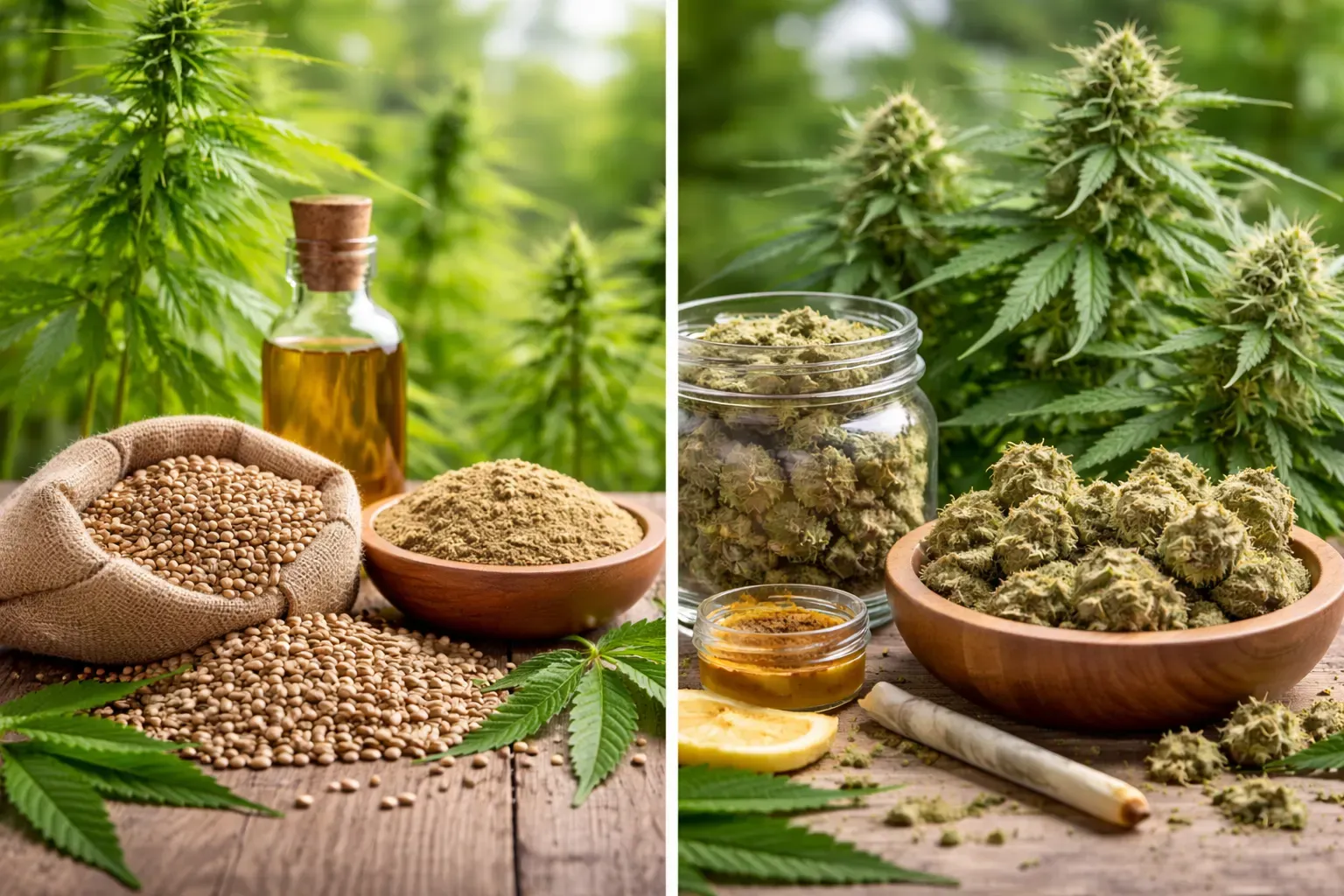
If you’ve ever felt confused about hemp vs cannabis, you’re not alone. These terms are often used as if they describe two completely different plants, but that’s not really the case. They come from the same plant family, yet they are usually separated by THC content, legal classification, and intended use. Once you understand those core differences, it becomes much easier to shop smarter, read labels better, and know what you’re actually buying.
Key points:
- Hemp and cannabis come from the same plant family, but hemp is usually defined by its very low THC content.
- Hemp is commonly used for CBD, seed, fiber, wellness products, and industrial applications, while cannabis is more often associated with THC-rich products.
- The difference between hemp and cannabis matters because it affects effects, legality, labeling, and how products are sold.
What is the difference between hemp and cannabis?
The simplest way to explain the difference between hemp and cannabis is this:
Hemp and cannabis are closely related forms of Cannabis sativa, but they are commonly classified based on THC levels, legal rules, and the purpose they are grown for.
That means the real hemp vs cannabis conversation is not just about plant biology. It’s also about how these plants are regulated and used in the real world.
Quick comparison
- Hemp = very low THC, often used for CBD, fiber, seed, and wellness products
- Cannabis = usually higher THC, often used for flower, vapes, edibles, and recreational or dispensary products
This is why many consumers get confused. A product can come from the same broader plant family but still have very different effects and legal treatment depending on what’s inside it.
According to the CDC, hemp is federally defined as cannabis containing no more than 0.3% delta-9 THC under current legal standards, while cannabis products with higher THC may fall into a different legal category.
Are hemp and cannabis the same plant?
Yes, in a broad sense, they come from the same plant family.
That surprises a lot of people because hemp and cannabis are often marketed as if they are totally unrelated. But from a botanical point of view, they are part of the same group.
Where the split happens is in:
- THC content
- breeding goals
- legal status
- end use
This is why the difference between hemp and cannabis can feel confusing if you only look at the names and not the actual product.
What does hemp vs marijuana mean?
This is one of the most common points of confusion.
In many consumer conversations, hemp vs marijuana is basically another way of saying:
- low-THC cannabis
versus - higher-THC cannabis
In practice, “marijuana” is often used as the older legal or cultural term for cannabis products that are more intoxicating or THC-heavy.
So when people compare hemp vs marijuana, they are usually asking whether the product is more likely to be:
- non-intoxicating or mild
- or psychoactive and stronger
That’s why the terms overlap so often in real-world shopping and online searches.
What is the hemp plant vs cannabis plant difference?
Many people expect hemp and cannabis to look obviously different, but it’s not always that simple.
There are some common visual patterns, though.
Typical hemp plant traits
- Taller growth
- Thinner stalks
- Fewer branches
- Often grown closely together in larger fields
- Commonly bred for fiber, seed, or CBD biomass
Typical cannabis plant traits
- Shorter and bushier growth
- More branching
- Often grown with more spacing
- Usually bred for flower production and cannabinoid-rich buds
That said, you cannot always tell the hemp plant vs. the cannabis plant difference just by looking at it. Some CBD-rich hemp flower can look almost identical to THC-rich cannabis flower, especially once it has been trimmed and packaged.
This is why lab testing matters more than appearance.
How do cannabinoids differ in hemp and cannabis?
This is one of the most useful parts of the hemp vs cannabis discussion for everyday consumers.
Both hemp and cannabis can contain compounds like:
- THC
- CBD
- CBG
- CBC
- terpenes
- minor cannabinoids
The biggest difference is usually the ratio and concentration.
What is usually found in hemp?
Hemp products are more commonly associated with:
- low THC
- higher CBD
- little to no intoxicating effect in traditional forms
This is why hemp is often marketed for people who want cannabinoids without the classic “high.”
What is usually found in cannabis?
Cannabis products sold in dispensaries are more commonly associated with:
- higher THC
- stronger psychoactive effects
- more obvious recreational or intoxicating use
That’s the main practical difference in the CBD hemp vs cannabis conversation.
A useful reality check
CBD is still CBD whether it comes from hemp or cannabis.
What usually changes is:
- the THC level
- how the product is labeled
- How it is sold
- whether it may cause impairment
So if you’re trying to compare CBD hemp vs cannabis products, the smarter move is to look at the actual cannabinoid content, not just the word on the label.
What are the main uses of hemp?
Hemp has a much wider use range than many people realize.
Common hemp uses
- CBD oils and tinctures
- topicals and skincare
- hemp seed oil
- protein powders
- textiles
- paper
- rope
- building materials
- food products
This is one of the biggest hemp and cannabis differences in the market. Hemp often exists in both the wellness space and the industrial world.
That’s a major reason why hemp is talked about very differently than dispensary cannabis.
What are the main uses of cannabis?
Cannabis is more often associated with products that are designed for stronger cannabinoid effects, especially THC-rich experiences.
Common cannabis uses
- flower
- pre-rolls
- edibles
- vapes
- concentrates
- tinctures
- beverages
- topicals
This is why many people searching for hemp vs cannabis are really trying to understand the difference between a wellness-style product and a more traditional cannabis experience.
What are the benefits of hemp vs cannabis?
This part matters, but it also needs to stay honest.
There is no one universal answer to cannabis vs hemp benefits because the effects depend on:
- the product type
- the cannabinoid profile
- the THC level
- the CBD level
- your body
- your tolerance
- your goals
Still, there are some common reasons people choose one over the other.
Why do people use hemp products?
People often choose hemp-based products because they want:
- lower THC
- CBD-focused support
- non-intoxicating routines
- hemp-based wellness items
- seed, oil, or food products
Why do people use cannabis products?
People often choose cannabis products because they want:
- THC-rich flower
- stronger effects
- a recreational experience
- more obvious psychoactive impact
- a dispensary-style product range
That’s the most useful way to understand cannabis vs hemp benefits in plain English.
Is hemp legal, and cannabis illegal?
This is where things get complicated fast.
The short answer is: sometimes, depending on the product and where you live.
In simple terms
- Hemp is generally legal under federal rules if it meets the THC threshold
- Cannabis products with higher THC may still be federally restricted, even if they are legal at the state level
This is where hemp legality vs cannabis gets messy.
Why legality still confuses people
Because the law does not always match the marketing.
A product may say “hemp” on the package, but that does not always mean it is simple, mild, or universally legal.
Laws can vary based on:
- THC content
- state regulations
- product format
- whether the product contains intoxicating cannabinoids
That’s why it’s smart to treat hemp legality vs cannabis as a label-checking issue, not just a keyword issue.
Can hemp get you high?
Usually, traditional hemp products are not designed to get you high.
But there’s an important catch.
Hemp products that usually do not cause a high
- CBD isolate
- hemp seed foods
- standard low-THC hemp wellness products
Hemp-derived products that may still be intoxicating
Some products marketed as hemp may still contain:
- delta-8 THC
- delta-9 THC in certain formulations
- other psychoactive cannabinoids
So yes, some “hemp” products can still affect you more than expected.
That’s why reading the full label matters much more than assuming hemp always means non-intoxicating.
Which is better: hemp or cannabis?
This is not really a “better or worse” situation. It’s more about fit.
A better question is:
What are you trying to get from the product?
Hemp may be better if you want
- lower THC
- CBD-focused use
- non-intoxicating options
- wellness or topical products
- hemp food or seed products
Cannabis may be better if you want
- THC-rich flower
- stronger psychoactive effects
- dispensary products
- a more traditional cannabis experience
That’s the cleanest way to think about hemp vs cannabis without getting lost in hype or outdated assumptions.
How can you shop smarter when comparing hemp and cannabis?
If you want to make better buying decisions, focus less on buzzwords and more on what is actually in the product.
Check these before buying
- THC percentage
- CBD percentage
- lab testing
- ingredient list
- product type
- brand reputation
- freshness
- packaging date
- state legality
If a product has vague claims, weak labeling, or unclear ingredients, it’s usually best to move on.
That one habit alone can save you from a lot of low-quality products.
Also read: How to Use Cannabis Safely?
FAQ: Hemp vs Cannabis
1. What is the difference between hemp and cannabis?
The difference between hemp and cannabis usually comes down to THC content, legal status, and intended use. Hemp is generally lower in THC, while cannabis is more often associated with stronger psychoactive effects.
2. What is the hemp plant vs cannabis plant difference?
The hemp plant vs cannabis plant difference often comes down to growth style and breeding. Hemp is usually taller and thinner, while cannabis grown for flower is often shorter and bushier.
3. Is hemp vs marijuana the same as hemp vs cannabis?
In many everyday conversations, yes. Hemp vs marijuana is often another way of discussing hemp vs cannabis, especially when comparing low-THC hemp to higher-THC cannabis products.
4. How does CBD hemp vs cannabis compare?
In the CBD hemp vs cannabis comparison, the CBD itself may be similar, but the THC level, legal category, and overall product experience can be very different.
5. What should I know about hemp legality vs cannabis?
The biggest thing to know about hemp legality vs cannabis is that laws vary by location, and some hemp-derived products may still be intoxicating or restricted depending on how they are made and sold.
Final thoughts
Understanding hemp vs cannabis gets much easier once you stop treating them like two totally separate worlds. They come from the same plant family, but they are used, regulated, and sold in very different ways. If you want to make better product choices, focus on cannabinoid content, product testing, and label clarity instead of just marketing language. For more easy-to-understand cannabis education and beginner-friendly product guidance, Natural Buds is a smart place to keep learning.