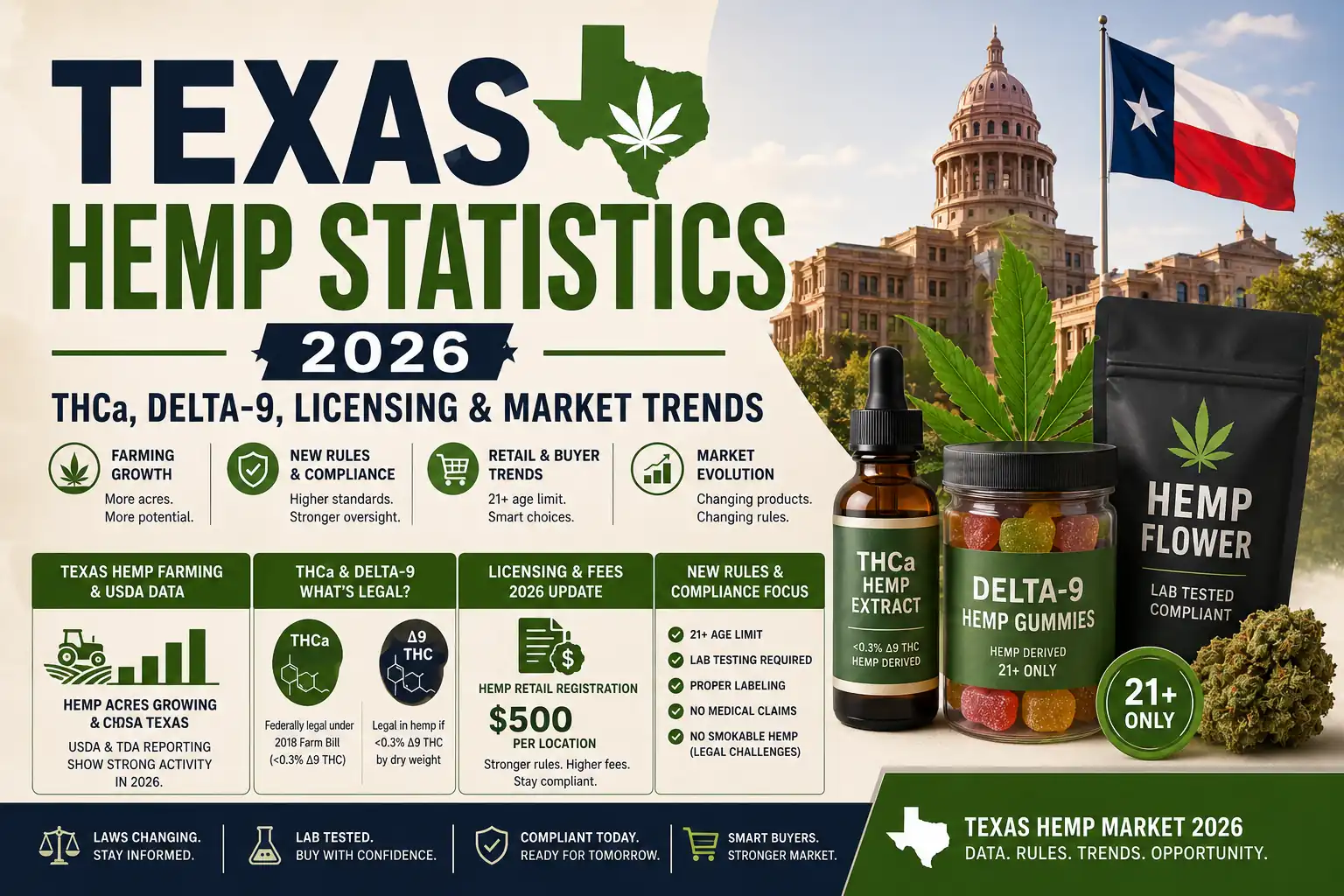
Texas hemp statistics 2026 show a market that is growing in farming activity, but facing major pressure from new rules, court cases, age limits, licensing costs, and product testing standards.
For consumers, the big questions are simple: what can you buy, how do you know it is tested, and what changed around THCa and Delta-9? For sellers and dispensaries, the bigger issue is compliance. Texas now has higher hemp retail registration fees, stronger labeling rules, age checks for buyers 21 and older, and an active legal fight around smokable hemp products.
Quick takeaways
- Texas hemp farming expanded sharply in USDA data, with 6,700 planted acres and 4,650 harvested acres in 2025, up from 4,900 planted and 1,500 harvested acres in 2024.
- DSHS rules require sellers to verify that buyers are 21 or older before selling consumable hemp products.
- THCa and Delta-9 rules are under close watch because the state’s testing framework includes formulas that account for THCA conversion into THC.
What do the Texas hemp statistics 2026 show first?
The first thing to know is that Texas is both a hemp production state and a large consumable hemp retail state. The Texas Department of Agriculture handles hemp growing, sampling, transport manifests, crop permits, and producer licensing. The Texas Department of State Health Services handles consumable hemp products, including manufacturing, processing, labeling, retail registration, and public rosters for licensees and registrants.
The national hemp market also rebounded in 2025. USDA reported that the total value of U.S. hemp production in the open and under protection reached $739 million in 2025, up 64% from 2024. Open-field hemp planted area reached 49,267 acres, and harvested area reached 43,707 acres.
USDA hemp data table
| Hemp data point | Texas 2024 | Texas 2025 | What it means |
| Hemp grown in the open, planted in acres | 4,900 | 6,700 | Texas acreage expanded year over year |
| Hemp grown in the open, harvested acres | 1,500 | 4,650 | Harvested acres grew much faster than planted acres |
| Hemp grown under protection area | 150,000 sq. ft. | 150,000 sq. ft. | Indoor or protected area stayed flat |
| 2025 U.S. total hemp value | Not state-specific | $739 million nationally | National production value rose 64% from 2024 |
| 2025 U.S. floral hemp value | Not state-specific | $574 million nationally | Floral hemp remained the biggest value category |
| 2025 U.S. fiber production | Not state-specific | 67.3 million pounds nationally | Fiber volume rose 11% from 2024 |
USDA withholds some state-level category data when it could reveal individual operations, so not every Texas floral, grain, fiber, or seed value is public. That is why the best Texas crop signal is the open-field planted and harvested acreage table.
Why does THCa matter in Texas hemp?
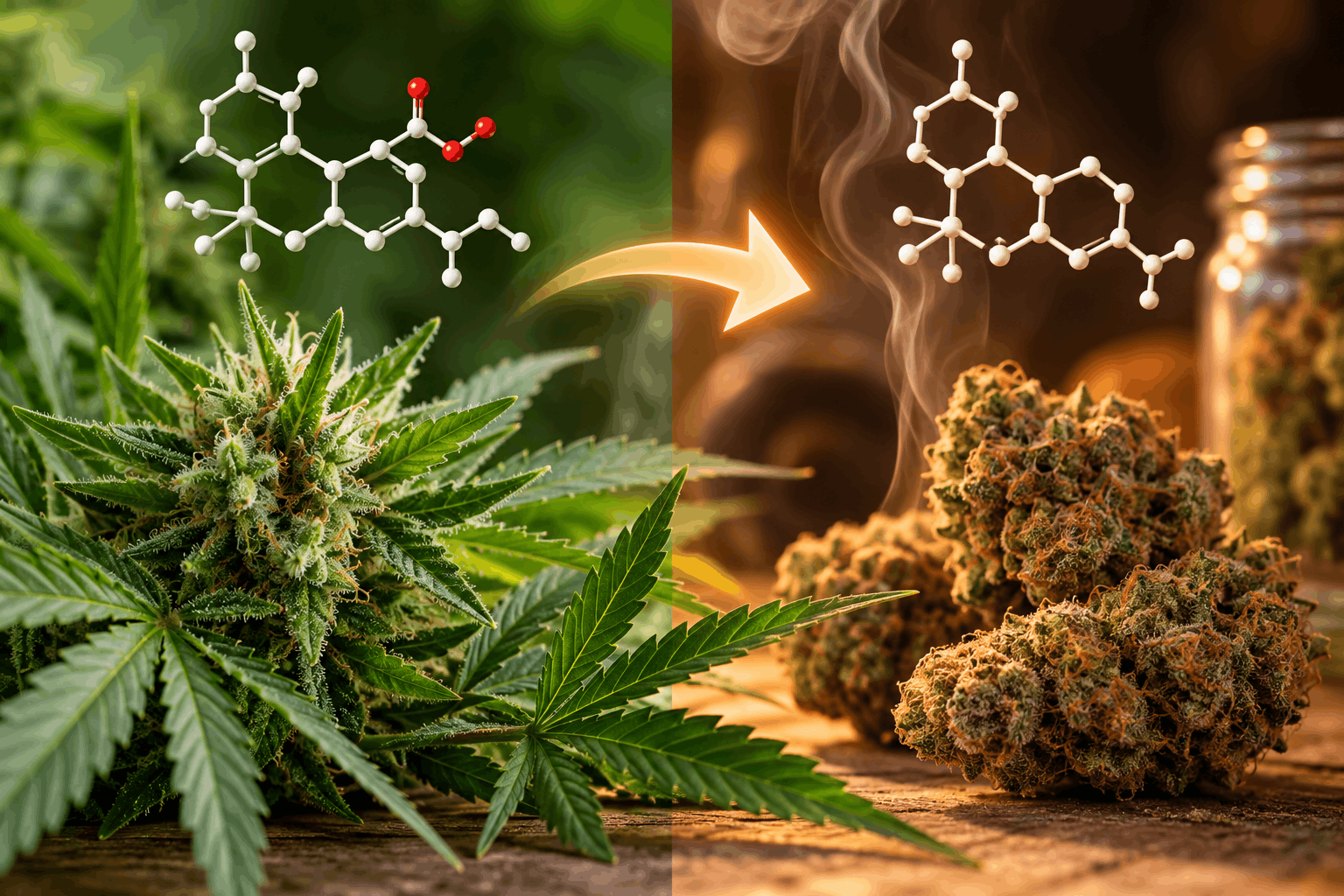
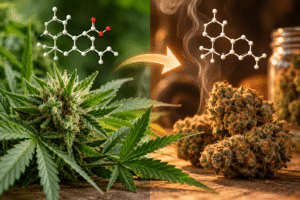
THCa matters because it can convert into THC when heated. That is why many regulators focus on total THC or total delta-9 THC formulas, not only the amount of delta-9 THC shown before heating.
DSHS rules define THCA as a precursor to tetrahydrocannabinols. The rules also define total THC using a formula that includes THCA: Total THC = 0.877 x THCA + THC. They also define total delta-9 THC using a similar THCA conversion formula.
For shoppers, this means a product label or certificate of analysis should not be treated casually. You should look for:
- Delta-9 THC percentage
- Total delta-9 THC
- Total THC
- THCA amount
- Batch number
- Lab name
- QR code or COA access
- Expiration date
- Serving size in milligrams
For sellers, THCa products need special attention because testing and enforcement can change product risk fast. If a product depends on high THCA but low measured delta-9 THC, it may become harder to sell when regulators use total THC or total delta-9 formulas.
How do Delta-9 hemp rules work in Texas?
Texas hemp law follows the hemp concept created after the 2018 Farm Bill and Texas House Bill 1325. The Texas Department of Agriculture says HB 1325, signed in June 2019, authorized the production, manufacture, retail sale, and inspection of industrial hemp crops and products in Texas.
Under DSHS rules, consumable hemp product testing must include cannabinoid identity, delta-9 THC, total delta-9 THC, total THC, residual solvents, heavy metals, pesticides, and harmful pathogens. A consumable hemp product must test at 0.3% total delta-9 THC or less on a dry weight basis when measurement uncertainty is considered.
That does not mean every Delta-9 product is automatically safe or compliant. It still needs:
- A valid COA
- Proper packaging
- Proper labeling
- Legal manufacturing or sourcing
- Age verification at retail
- DSHS registration or licensing, where required
What should consumers check before buying?
Ask to see the COA. If the seller cannot provide one, be careful. DSHS rules require testing results to be provided to consumers, the Texas Alcoholic Beverage Commission, and DSHS upon request.
What changed for Texas hemp rules in 2026?
Texas hemp rules changed in several ways, and some parts are still being challenged in court. DSHS posted the adopted consumable hemp rule text that was scheduled for publication in the March 20, 2026, Texas Register, with rules effective March 31, 2026.
At the same time, a Travis County judge temporarily blocked enforcement of parts of the new rules tied to smokable hemp. KUT reported that the challenged rules changed THC calculations in a way that effectively prohibited smokable hemp products such as flower and concentrates. The same report said the judge blocked the new rules prohibiting smokable hemp sales, but did not block higher fees.
Rule changes table
| Rule area | 2026 status | Why it matters |
| Buyer age | Buyers must be 21 or older for consumable hemp products | Retailers must check a valid government ID |
| Retail registration fee | $5,000 per location | Major cost increase for small shops |
| Manufacturing or processing license fee | $10,000 per facility, plus online fee in DSHS guidance | Raises the cost of making or processing products |
| Product testing | Must include cannabinoids, delta-9 THC, total delta-9 THC, total THC, solvents, metals, pesticides, and pathogens | Makes COAs more important |
| Labeling | Labels must include THC warnings, COA access, serving size, and FDA disclaimer | Helps buyers understand risk |
| Packaging | Must be tamper-evident, child-resistant, and resealable for multi-serving products | Raises safety and compliance standards |
| Smokable hemp rules | Partly blocked in court as of April 2026 reporting | Retailers should verify the current legal status before stocking |
| Manufactured delta-8 THC | Texas Supreme Court allowed DSHS scheduling approach to stand | May affect the synthetic or manufactured cannabinoid product strategy |
The Texas Supreme Court issued a May 1, 2026 decision in Texas Department of State Health Services v. Sky Marketing Corp., holding that the commissioner acted within broad statutory discretion and reversing the lower-court injunction related to manufactured delta-8 THC scheduling.
What does Texas license data show?
The Texas hemp market is not small. DSHS publishes current rosters for Consumable Hemp Product Licensees and Retail Hemp Registrations, plus a public license search tool that lets users search by name, license type, city, or county.
KUT reported in April 2026 that more than 13,000 stores were registered to sell hemp products in Texas, and almost 800 companies were licensed to manufacture hemp products, based on DSHS-posted data.
Texas license data table
| License or registration item | Current public signal | What it means for businesses |
| Retail hemp registrations | More than 13,000 stores reported by KUT from DSHS data | Retail access is widespread across Texas |
| Consumable hemp product licensees | Almost 800 companies reported by KUT from DSHS data | The manufacturing and processing base is large |
| Retail registration fee | $5,000 per location | Multi-location retailers face higher fixed costs |
| Consumable hemp product license fee | $10,000 per facility, plus DSHS online fee guidance lists $10,300 total | Processing and manufacturing require higher capital |
| Retail registration term | 1 year | Renewals must be managed annually |
| Consumable hemp product license term | 1 year | Expired licenses are not valid |
| Producer license and lot crop permits | Required through TDA for growing and planting areas | Farmers need TDA approval before planting and movement |
TDA says a producer license is needed before applying for a Lot Crop Permit, and an LCP is required for each planting area before planting begins. TDA also says crops must be harvested within 30 days from sampling, or a second official sample is required.
Which hemp product categories are shaping the Texas market?
The Texas hemp market includes many product types. Some are easier to understand. Others have higher legal risk because they involve intoxicating cannabinoids, THCa conversion, inhalable formats, or manufactured cannabinoids.
Market categories table
| Product category | Consumer demand signal | Compliance concern |
| Delta-9 gummies | Popular because dosing is clear and familiar | Must meet THC limits, COA, labeling, packaging, and age rules |
| THCa flower | Popular with smokable hemp buyers | Legal status is sensitive because THCA can count toward total THC formulas |
| Hemp flower and pre-rolls | Strong demand where smokable products are sold | Rules have been challenged and partially blocked in court |
| CBD oils and tinctures | Common wellness product | Still needs a compliant label, COA, and legal sourcing |
| Hemp beverages | Growing interest in low-dose formats | Serving size, label warnings, and THC limits matter |
| Topicals | Often lower concern for intoxication | Claims must avoid improper medical marketing |
| Delta-8 products | Historically large market | Manufactured delta-8 faces major risk after the Texas Supreme Court ruling |
| Fiber, grain, and seed hemp | Agricultural and industrial use | Less tied to retail intoxicating hemp, but still part of the USDA crop data |
For sellers, Texas hemp statistics 2026 point to one clear strategy: move away from vague product claims and build compliance into every sale. That means verified sourcing, updated COAs, staff training, proper registration, and clear customer education.
What should buyers know before shopping?
Texas consumers should be careful, especially with products that feel similar to marijuana. Legal hemp products may still contain THC. DSHS labeling rules require warnings that a product may contain THC, may cause a user to fail a drug test, and that all THCs have psychoactive properties. Labels must also warn that the product has not been evaluated by the FDA.
Before buying, check:
- Are you 21 or older?
- Is the store registered?
- Does the product have a recent COA?
- Does the COA match the batch number?
- Does the package have serving size information?
- Is it child-resistant?
- Are the THC values clear?
- Are there medical claims on the package?
Avoid products with cartoon-style packaging, unclear dosage, missing lab reports, or claims that sound too strong. DSHS rules prohibit misleading packaging that may make someone believe the package does not contain hemp-derived cannabinoids or that the product is intended for medical use.
What should sellers and dispensaries do now?
Retailers, smoke shops, CBD stores, and hemp dispensaries should treat 2026 as a compliance-first year.
Use this checklist:
- Review every product COA
Check delta-9 THC, total delta-9 THC, total THC, THCA, batch number, and expiration. - Update age-check procedures
Staff should check valid government ID before completing the sale of any consumable hemp product. - Budget for fees
A $5,000 retail registration per location can change store economics fast. Manufacturing or processing costs are higher too. - Train staff on THCa and Delta-9
Staff should be able to explain why total THC formulas matter without making legal promises. - Watch court updates
Smokable hemp and manufactured cannabinoids have active legal and regulatory pressure. - Keep labels clean
No medical claims. No child-friendly packaging. No missing THC warnings. - Build a safer product mix
Consider compliant low-dose gummies, beverages, CBD tinctures, topicals, and clearly tested products.
How did the 2025 THC ban debate affect 2026?
Texas almost moved toward a much stricter THC ban in 2025. Senate Bill 3 would have banned consumable hemp products containing any THC, including delta-8 and delta-9, but Governor Greg Abbott vetoed it and called for regulation instead. He urged lawmakers to consider rules such as minor restrictions, testing, local controls, and enforcement funding.
That political fight still shapes 2026. The market did not disappear, but the direction is clear: Texas lawmakers and agencies are moving toward tighter oversight. Sellers should not assume rules will stay the same for long.
FAQ
1. What are the Texas hemp statistics 2026 showing?
They show rising hemp acreage, a large retail registration base, higher license fees, stricter age checks, stronger testing rules, and legal uncertainty around smokable hemp, THCa, and manufactured delta-8 products.
2. Is THCa legal in Texas in 2026?
The status is complicated. DSHS rules define THCA and include THCA in total THC and total delta-9 THC formulas. Court orders have affected the enforcement of some smokable hemp restrictions, so buyers and sellers should verify the current status before purchasing or stocking THCa products.
3. Can people under 21 buy hemp products in Texas?
No. DSHS says sellers must verify each purchaser is 21 or older by checking a valid government-issued ID before completing the sale of any consumable hemp product.
4. What is the Texas hemp retail registration fee in 2026?
The DSHS adopted rule lists a retail hemp registration or renewal fee of $5,000 for each location before the sale of consumable hemp products.
5. What is the Texas consumable hemp product license fee?
The DSHS adopted rule lists a $10,000 fee per facility for manufacturing or processing consumable hemp products, and DSHS guidance lists a one-year license cost of $10,300 per location, including the Texas Online fee.
6. Are Delta-9 gummies legal in Texas?
Delta-9 hemp products may be sold only if they meet Texas and federal hemp limits, testing requirements, registration rules, labeling rules, age checks, and packaging rules. Products must test at 0.3% total delta-9 THC or less on a dry weight basis, with measurement uncertainty considered.
7. What happened to delta-8 in Texas?
On May 1, 2026, the Texas Supreme Court ruled in DSHS v. Sky Marketing Corp. that the DSHS commissioner acted within statutory discretion in the manufactured delta-8 THC scheduling dispute, reversing the lower-court injunction.
8. Where can Texas shoppers verify hemp businesses?
DSHS provides current licensee and registrant rosters, plus an online license search tool that allows searches by name, license type, city, or county.
Final thoughts
Texas hemp is not a quiet market anymore. It has real acreage growth, thousands of retail registrations, strong consumer demand, and serious rule pressure. Buyers should focus on tested products, clear labels, age rules, and responsible use.
Sellers should focus on registration, COAs, safe packaging, and staff training. The brands that survive will be the ones that treat compliance as part of customer trust, not just paperwork.Natural Buds supports safer, clearer, and more responsible hemp shopping for adults across Texas.