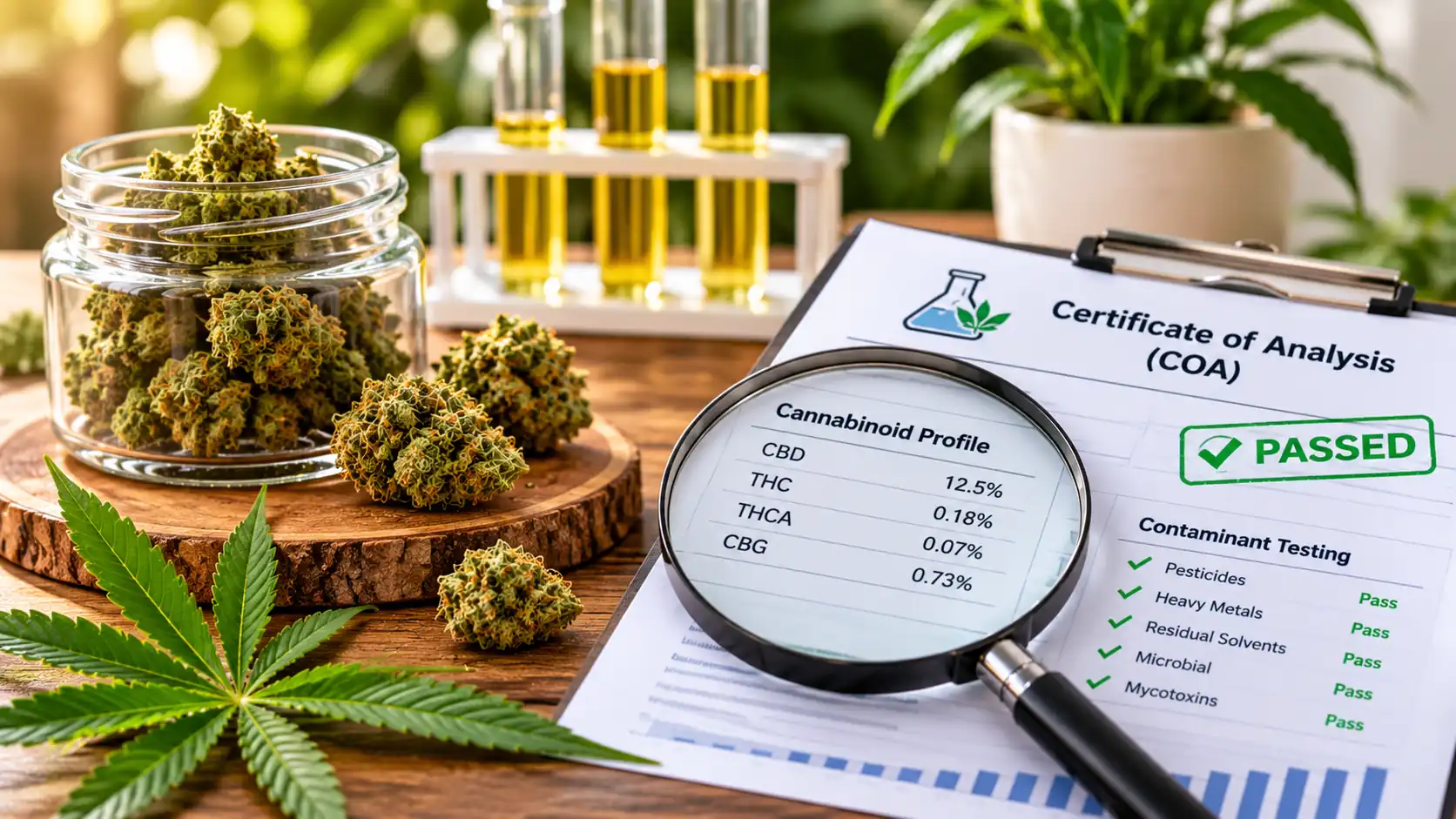
You scan the QR code on a hemp product and open a laboratory report. Suddenly, you are looking at percentages, cannabinoid names, and testing terms you have never seen before. How do you know what matters?
Learning how to read a hemp COA helps you understand what a product contains and which laboratory tests have been performed.
A Certificate of Analysis (COA) provides information about cannabinoid levels, potential contaminants, and the tested product batch. This guide breaks down the important sections so you can review hemp lab reports with greater confidence.
Quick Answer
To read a hemp COA, focus on five things:
- Laboratory details: Identify who performed the testing.
- Product and batch information: Make sure the report matches your product.
- Cannabinoid levels: Review CBD, Delta-9 THC, THCA, and other reported cannabinoids.
- Contaminant results: Check which safety-related tests were performed and their outcomes.
- Testing dates: Confirm when the sample was analyzed and whether the report is final.
A COA provides results for a particular tested sample. It does not guarantee that every product is completely safe.
What Is a Hemp Certificate of Analysis (COA)?
A hemp Certificate of Analysis (COA) is an official laboratory document showing the results of tests performed on a hemp sample.
Hemp manufacturers use COAs to provide detailed information about cannabinoid concentrations and, when included, substances such as pesticides, heavy metals, and microbial contaminants.
Unlike a product label, which summarizes information for shoppers, a COA provides specific laboratory measurements.
However, not every report includes the same testing categories. Some cover cannabinoid potency only, while others include contaminant testing.
A COA helps you understand the tested sample, but it is not an unconditional guarantee of product quality, safety, or legal compliance.
How to Find the Correct COA for a Hemp Product
Before reviewing the numbers, make sure you have the correct report.
You can usually find a hemp COA through:
- QR codes: Scan the code printed on the product packaging.
- Manufacturer websites: Look for laboratory results on product pages.
- Batch lookup pages: Search using the product’s batch or lot number.
Once you open the document, compare the product name and batch number with the packaging.
Also check whether the laboratory tested the finished product or a raw hemp ingredient. Results from raw materials do not necessarily represent the finished product.
At Natural Buds, shoppers can explore the available Lab Work resources for product testing information.
If the correct report is unavailable or the batch details do not match, contact the manufacturer or retailer for clarification.
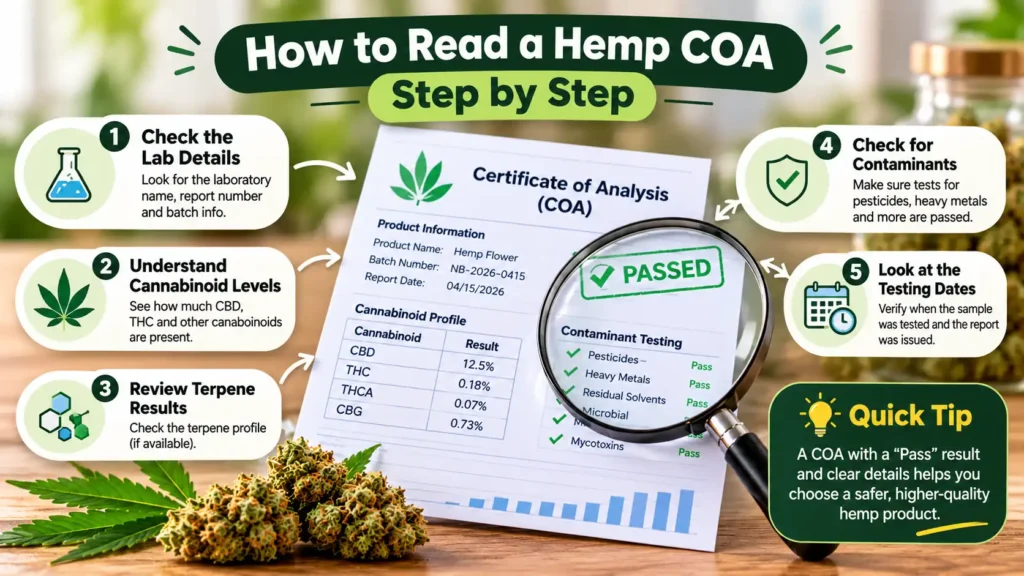
How to Read a Hemp COA Step by Step
Most hemp lab reports become easier to understand when you know where to look.
Here are five simple steps.
Step 1: Check the Laboratory and Batch Details
Start at the top of the report.
Look for the testing laboratory’s name, contact information, report number, and sample identification details.
The product name and batch number should match the item you are checking.
Third-party testing means the analysis was performed by a laboratory separate from the product manufacturer.
Some testing laboratories also hold ISO/IEC 17025 accreditation, which demonstrates technical competence for specified testing activities.
If the laboratory cannot be identified or the report details seem inconsistent, ask for verification before relying on the results.
Step 2: Understand Cannabinoid Levels
The cannabinoid profile is one of the most important parts of a hemp COA.
It shows which cannabinoids were measured and their concentrations in the tested sample.
Common cannabinoids include:
- CBD (Cannabidiol): A cannabinoid that does not typically produce a THC-like high.
- CBDA: The acidic precursor to CBD.
- CBG (Cannabigerol): Another naturally occurring cannabinoid.
- CBN (Cannabinol): A cannabinoid that can form as THC changes over time.
- Delta-9 THC: The primary intoxicating cannabinoid associated with cannabis.
- THCA: A cannabinoid that can convert into Delta-9 THC when heated.
Cannabinoid concentrations may appear as percentages or milligrams per gram (mg/g).
For example, 1% CBD by weight equals 10 mg of CBD per gram of tested material.
For packaged products, compare the laboratory results with the label using matching units. You may need the product’s weight or serving information to calculate the total milligrams.
Understanding Delta-9 THC, THCA, and Total THC
Delta-9 THC and THCA are different compounds. THCA can convert into Delta-9 THC when exposed to heat.
Some reports include a calculated Total THC value to account for this potential conversion.
A commonly used formula is:
Total THC = Delta-9 THC + (THCA × 0.877)
Here is a simplified example:
| Cannabinoid | Example Result | Meaning |
| CBD | 12.5% | Measured CBD concentration |
| Delta-9 THC | 0.10% | Measured Delta-9 THC |
| THCA | 0.05% | Measured THCA |
| Total THC | 0.144% | Calculated potential THC |
These values are hypothetical examples, not actual Natural Buds product results.
The USDA’s hemp testing guidance explains how potential THCA conversion is considered in hemp crop testing.
Keep in mind that hemp cultivation rules and finished-product requirements are not always the same. Legal interpretation depends on the product and applicable regulations.
For a closer look at these cannabinoids, read Natural Buds’ guide to THCA vs. Delta-9 THC.
Step 3: Review Terpene Results
Some hemp COAs include a terpene profile.
Terpenes are naturally occurring compounds that contribute to a plant’s aroma. Common examples include myrcene, limonene, and pinene.
Laboratories may report terpene concentrations as percentages or milligrams per gram.
Not every hemp product undergoes terpene testing, so this section may be absent.
Terpene results can help describe a sample’s chemical composition, but they do not prove that a product will produce particular effects or medical benefits.
Step 4: Check Contaminant Testing
Hemp product lab testing may include checks for substances that could raise quality or safety concerns.
Common testing categories include:
- Pesticides: Residues from certain agricultural chemicals.
- Heavy metals: Substances such as lead, arsenic, cadmium, and mercury.
- Residual solvents: Chemicals that may remain after extraction or processing.
- Microbial contaminants: Certain bacteria, molds, and other microorganisms.
- Mycotoxins: Harmful substances produced by certain molds.
You may see results marked PASS, FAIL, or ND.
PASS means the tested sample met the stated criteria for that specific analysis.
FAIL means the sample did not meet those criteria.
ND (Not Detected) means the laboratory did not detect a substance at its stated detection limit. It does not necessarily mean the concentration is absolutely zero.
Remember that a report showing PASS for cannabinoid potency does not automatically mean the product passed contaminant testing.
Always check which tests were actually performed.
Step 5: Verify Testing Dates
A hemp COA may include several dates:
- Sample collection date.
- Sample received date.
- Testing date.
- Final report issue date.
These details help establish when laboratory testing occurred.
Check whether the report is final rather than preliminary.
An older COA is not necessarily invalid, but it should correspond to the product batch you are reviewing.
If the product belongs to a newer batch, do not assume results from an earlier batch apply to it.
Common Hemp COA Terms Explained
Laboratory reports often contain abbreviations that can look confusing.
Here is a simple reference:
| Term | Meaning |
| ND | Not Detected at the laboratory’s stated detection limit |
| LOD | Limit of Detection, the lowest concentration a test can detect |
| LOQ | Limit of Quantification, the lowest concentration a test can reliably measure |
| PASS / FAIL | Whether a result meets specified testing criteria |
| mg/g | Milligrams per gram |
| % | Percentage concentration |
| Batch/Lot Number | An identifier used to track a product batch |
Understanding these terms makes it easier to interpret a hemp lab report without needing a scientific background.
Red Flags to Watch for in a Hemp Lab Report
Not every COA provides enough information to evaluate a product properly.
Watch for these warning signs:
- Missing laboratory details: The testing facility cannot be identified.
- Mismatched batch numbers: The report does not match the product packaging.
- Unclear testing dates: The report does not show when testing occurred.
- Missing relevant contaminant tests: Important testing categories are not included.
- Unverifiable results: The report’s authenticity cannot be reasonably confirmed.
- Incomplete testing claims: A potency-only report is presented as proof of comprehensive safety testing.
- Label inconsistencies: Cannabinoid results differ significantly from product claims without explanation.
These warning signs do not always prove that a product is defective. However, they are good reasons to ask the manufacturer or retailer for more information.
Does a Passing COA Mean a Hemp Product Is Safe?
A passing COA provides useful information, but it does not guarantee that a hemp product is completely safe.
Laboratory findings apply to the tested sample and the specific analyses performed.
Product handling, storage, manufacturing practices, labeling, and individual health considerations also matter.
The FDA warns that some cannabinoid products may contain inaccurate cannabinoid amounts or contaminants and can carry health risks.
Use laboratory results alongside other available product information rather than treating a passing report as a complete safety guarantee.
Final Takeaway
Learning how to read a hemp COA does not require a scientific background. Once you understand the main sections, laboratory reports become much easier to navigate.
Start by matching the product and batch information. Then review the cannabinoid profile, look for relevant contaminant results, and check the testing dates.
These simple checks can help you understand what the laboratory actually measured before making a purchasing decision.
At Natural Buds, we believe product education and transparency matter. Explore our available hemp products and lab testing resources to make more informed shopping choices.
Frequently Asked Questions About Hemp COAs
1. Is a hemp COA the same as a lab report?
A hemp COA is a formal document that reports specific laboratory test results. People often use the terms interchangeably, although “lab report” can refer to a broader range of testing documents.
2. How can I check whether a hemp COA is genuine?
Check the laboratory name, report number, product name, and batch details. If the laboratory provides an online verification system, use it. You can also contact the testing facility or manufacturer to confirm the report’s authenticity.
3. Does every hemp product need a COA?
Testing and documentation requirements depend on the product type and jurisdiction. In Texas, regulated consumable hemp products have specific testing and labeling requirements, including access to applicable COA information. The Texas Department of State Health Services provides guidance on these requirements.
4. Does a new hemp product batch need a new COA?
Batch-specific testing helps connect laboratory results to the products being sold. Depending on applicable requirements, a new production batch may require additional testing. Always look for a report that matches the product’s batch or lot information.