Shopping for hemp products in Fort Worth has become more confusing in 2026. Some stores still offer products labeled Delta-8, THCA, or hemp-derived THC, while news reports discuss new restrictions and possible bans.
So, what can you actually buy?
Texas hemp laws in 2026 have changed significantly, and more federal changes are approaching. The rules depend on the type of product, its cannabinoid content, and how the law classifies it.
If you’ve heard about the Texas hemp ban 2026, it’s important to understand what the restrictions actually cover.
This guide explains the major legal changes, how they affect different hemp products, and what Fort Worth shoppers should check before making a purchase.
Quick Answer: Are Hemp Products Legal in Texas in 2026?
Hemp is not completely banned in Texas, but not every hemp-derived product is legal.
Here’s what shoppers should know:
- Qualifying hemp products remain permitted under applicable Texas regulations.
- Delta-8 THC faces major restrictions following changes that took effect July 31, 2026.
- Updated THC calculations affect THCA flower and other hemp products.
- Texas requires buyers of regulated consumable hemp products to be at least 21 years old.
- Federal hemp rules will change again on November 12 and December 11, 2026, unless lawmakers make further changes.
A hemp-derived label does not automatically make a product legal. Its ingredients, THC levels, and applicable regulations matter.
What Are the Texas Hemp Laws in 2026?
Texas permits certain hemp products but controls how businesses manufacture, distribute, and sell them.
Under state law, consumable hemp products generally include foods, drugs, devices, and cosmetics containing hemp or hemp-derived cannabinoids.
Examples include CBD oils, gummies, topical products, and hemp-infused beverages.
The main legal distinction between hemp and marijuana has historically involved Delta-9 THC, the primary intoxicating compound found in cannabis.
The 2018 federal Farm Bill defined hemp as cannabis containing no more than 0.3% Delta-9 THC by dry weight.
However, that limit does not automatically make every finished hemp product legal.
Texas also regulates other cannabinoids, product testing, labeling, and age requirements. The Texas Department of State Health Services (DSHS) oversees the state’s Consumable Hemp Program.
For a better understanding of these classifications, explore our guide to hemp vs. cannabis.
The key point is simple: hemp and marijuana come from the same plant species, but their legal treatment depends on specific rules.
What Changed Under Texas Hemp Laws in 2026?
Several important changes have affected Texas hemp consumers this year. Three developments deserve particular attention.
March 31, 2026: New THC Calculations and Smokable Hemp Restrictions
Texas introduced stricter rules for measuring THC in consumable hemp products.
Under the DSHS rules effective March 31, 2026, laboratories must account for both Delta-9 THC and THCA when determining THC levels for relevant testing requirements.
THCA is a naturally occurring cannabinoid that can convert into Delta-9 THC when heated.
Why does this matter?
Previously, some products carried low Delta-9 THC percentages but contained much higher THCA levels.
The updated calculation considers that potential THC content, making compliance more difficult for many products marketed as THCA flower.
Texas also has separate restrictions affecting cannabinoid-containing vapes and e-cigarettes.
These rules have faced legal challenges. As of November 6, 2026, the relevant restrictions remain in effect while litigation continues.
For Fort Worth shoppers, this means hemp flower, vapes, and other consumable products may face different legal requirements.
The product’s form and actual cannabinoid content matter more than its marketing label.
July 31, 2026: Delta-8 THC Restrictions Reinstated
Another major change involves Delta-8 THC.
Delta-8 is an intoxicating cannabinoid that appears in some gummies, beverages, oils, and vape products.
On July 31, 2026, Texas reinstated controlled substance scheduling provisions that affect Delta-8 and certain other tetrahydrocannabinols.
According to Texas DSHS, authorities may detain products labeled as containing Delta-8 THC or products containing more than trace amounts of certain tetrahydrocannabinols. They may also refer these products to law enforcement.
The rules distinguish naturally occurring trace amounts from products containing larger quantities.
For consumers, the important point is that a hemp-derived label does not create an automatic legal exemption.
Even if a store displays a Delta-8 product, its availability does not prove that it meets Texas requirements.
November and December 2026: Federal Hemp Law Changes
Federal regulations are also changing.
In November 2025, Congress passed legislation that introduced a narrower definition of hemp. Lawmakers later delayed most of those changes.
The updated federal timeline includes two important dates:
| Date | What Changes |
|---|---|
| November 12, 2026 | Federal rules are scheduled to exclude certain hemp-derived cannabinoid products containing cannabinoids that cannabis plants cannot naturally produce. |
| December 11, 2026 | Most remaining changes to the federal hemp definition are scheduled to take effect. |
The December changes introduce a broader total THC standard that includes THCA.
They also restrict certain finished hemp-derived cannabinoid products containing more than 0.4 milligrams of combined total THC and other specified cannabinoids with similar effects per container.
This threshold applies to the container, not just an individual serving.
For example, a package containing several hemp-derived THC gummies may need evaluation based on the combined amount in the entire container.
These changes could affect some edibles, drinks, and other cannabinoid products.
The Congressional Research Service explains the federal timeline and its legal implications.
Remember: Texas can enforce its own hemp restrictions even before the upcoming federal changes take effect.
Is Hemp Legal in Texas in 2026?
Yes, qualifying hemp remains legal in Texas. However, different rules apply to different hemp products.
A CBD topical, a Delta-8 gummy, and a high-THCA flower product may have very different legal requirements.
Several factors influence a product’s legal status:
- Its cannabinoid content.
- The amount of THC and other restricted compounds.
- The product’s ingredients and manufacturing process.
- Whether it is an edible, topical, flower product, or vape.
- Current Texas and federal regulations.
The law also treats manufacturing, retail sales, and consumer possession differently in some circumstances.
For that reason, a product restriction does not always answer every question about possession.
If you’re wondering, “Is hemp legal in Texas 2026?” the most accurate answer depends on the specific product.
Rather than relying on broad claims about hemp legality, examine the product details and current rules.
What THC Products Are Legal in Texas in 2026?
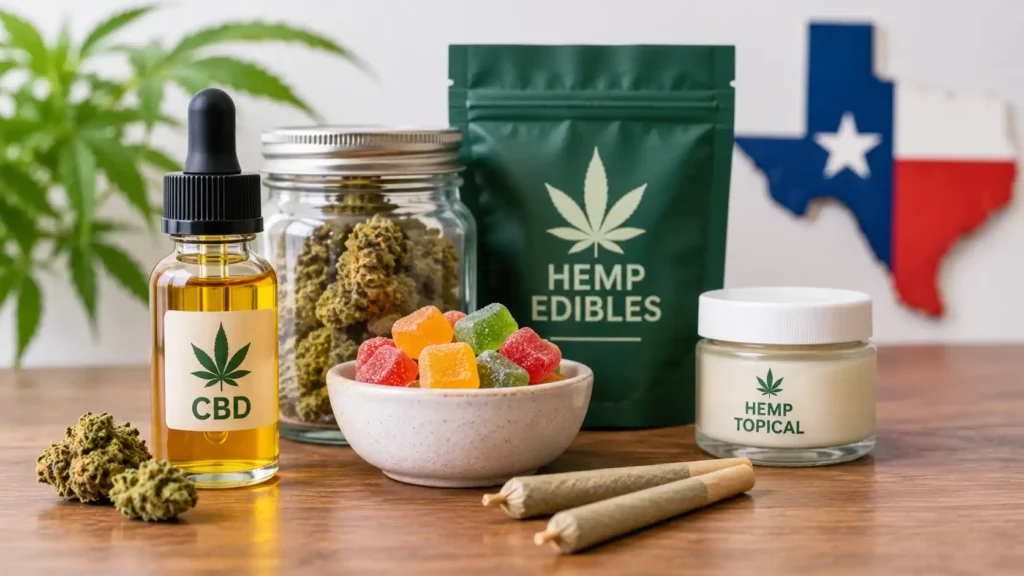
Understanding what THC products are legal in Texas requires looking at each product category separately.
The following overview explains the main considerations. It does not confirm the legal status of any individual product.
CBD Products
CBD remains one of the most familiar hemp-derived cannabinoids.
Qualifying CBD oils, topicals, and other consumable products may be sold in Texas when they meet applicable requirements.
Businesses must follow relevant rules covering cannabinoid limits, testing, labeling, and manufacturing.
However, not every CBD product has FDA approval.
Some CBD products also contain additional cannabinoids, so shoppers should review the complete ingredient and laboratory information.
Delta-8 THC Products
Texas’s controlled substance rules place major restrictions on Delta-8 THC products.
The restrictions affect products containing more than naturally occurring trace amounts of certain tetrahydrocannabinols.
This means a manufacturer cannot simply label a product “hemp-derived Delta-8” and assume it qualifies for legal sale.
Consumers should avoid treating store availability or marketing claims as proof of compliance.
THCA Flower and Other Smokable Hemp Products
THCA flower has created confusion because its chemical composition differs from traditional low-THC hemp products.
Although THCA and Delta-9 THC are different compounds, heat can convert THCA into Delta-9 THC.
Texas’s updated calculation considers this potential conversion when determining applicable THC levels.
As a result, many high-THCA flower products may exceed the relevant limits.
Texas also maintains separate restrictions on cannabinoid-containing vapes and e-cigarettes.
Our THCA vs. Delta-9 guide explains the differences between these cannabinoids in more detail.
Shoppers should not assume that every product marketed as THCA hemp meets Texas requirements.
Hemp-Derived Delta-9 THC Products
The existing federal hemp framework has used a maximum Delta-9 THC concentration of 0.3% by dry weight.
However, that percentage is only one part of the legal picture.
Texas applies additional requirements, including calculations that account for THCA.
The approaching federal changes will further restrict certain products based on total THC and other cannabinoid content.
This means a product that once qualified under the Delta-9 dry-weight standard may face different treatment after the new federal provisions take effect.
Hemp-Derived Edibles and Drinks
Hemp-derived gummies, chocolates, beverages, and other edibles can contain different cannabinoid combinations.
Two products may look similar but face different restrictions.
For example, a CBD-focused gummy and a Delta-8 gummy do not necessarily have the same legal status.
Serving size and total cannabinoid content also matter when reviewing product information.
Under the upcoming federal changes, the 0.4 mg limit for specified finished products applies per container rather than per serving.
Before purchasing an edible or beverage, review its full cannabinoid profile and applicable legal requirements.
Quick Comparison of Hemp Products in Texas
| Product Type | Main Legal Consideration |
|---|---|
| CBD products | May qualify under applicable hemp rules if requirements are met |
| Delta-8 THC products | Face significant controlled substance restrictions |
| THCA flower | Subject to THC calculations and smokable hemp rules |
| Hemp-derived Delta-9 products | Must meet relevant state requirements and changing federal limits |
| Hemp-derived edibles and drinks | Legality depends on ingredients, cannabinoid content, and product requirements |
This overview helps explain the differences between product categories. It does not replace checking a particular product’s legal status.
What Should Fort Worth Shoppers Check Before Buying Hemp Products?
With so many changes taking place, shoppers need reliable product information.
Whether you’re visiting a hemp store in Fort Worth or comparing products online, these seven steps can help.
1. Confirm the Age Requirement
Texas prohibits retailers from selling regulated consumable hemp products to people under 21.
Retailers must verify buyers’ ages using acceptable government-issued identification.
Bring valid ID when visiting a store.
2. Read the Complete Product Label
Don’t rely only on the front of the package.
Check the product name, cannabinoid concentrations, ingredients, manufacturer information, and serving details.
Words like “natural,” “premium,” and “hemp-derived” do not establish legal compliance.
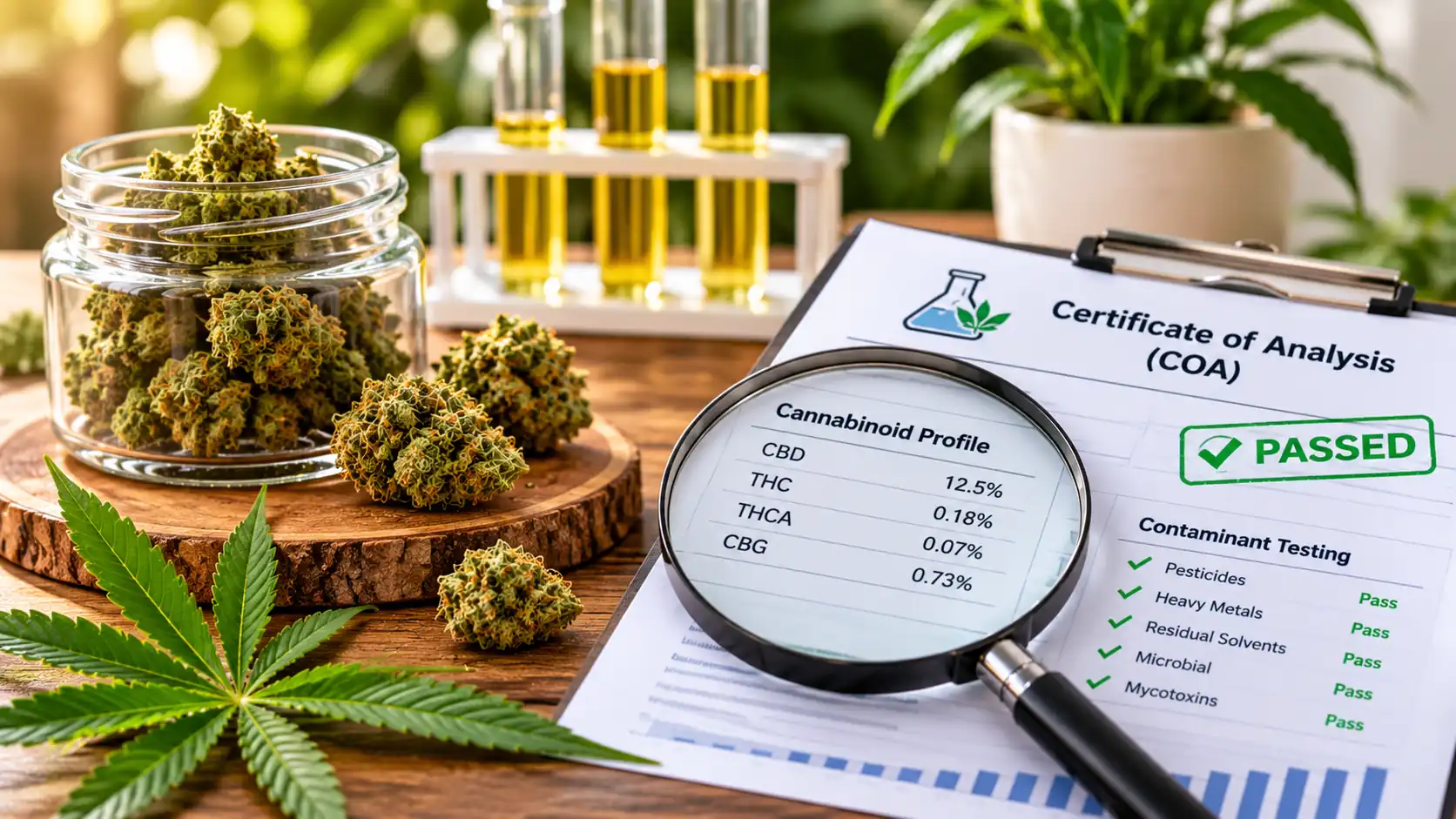
3. Review the Certificate of Analysis
A Certificate of Analysis (COA) provides laboratory results for a tested sample.
Look for cannabinoid concentrations, relevant contaminant testing, and laboratory identification.
Texas requires consumable hemp product labels to provide access to applicable COA information through a URL. A QR code alone does not replace this requirement.
If you’re unfamiliar with laboratory reports, read our guide on how to read a hemp COA.
Remember that laboratory testing provides useful product information, but it does not automatically establish legal compliance.
4. Match the Product Batch
Look for the batch or lot number on the package.
Compare that number with the laboratory report to confirm that both documents refer to the same product batch.
Results from a different batch may not describe the product you’re purchasing.
5. Check Packaging and Manufacturer Details
Review the package for required labeling information and applicable safety features.
Look for clear manufacturer contact details and instructions where appropriate.
Missing or unclear product information is a good reason to ask questions.
6. Ask the Retailer Questions
A retailer should be able to help you locate available product information.
Consider asking:
- Where can I find the laboratory report for this batch?
- Which cannabinoids does the product contain?
- Where can I find updated information about Texas hemp requirements?
Clear answers can help you understand a product, but retailer statements should not replace official legal guidance.
7. Review Current Texas Regulations
Hemp laws can change through legislation, agency rules, and court decisions.
Before making decisions based on older articles, check the Texas DSHS Consumable Hemp Program and the Texas State Law Library’s hemp resources.
For additional consumer information, explore our cannabis safety tips.
Final Thoughts: Understanding Texas Hemp Laws Before You Buy
Texas hemp laws have changed significantly in 2026, and upcoming federal rules will bring further restrictions.
Fort Worth shoppers should pay particular attention to Delta-8 regulations, THCA calculations, THC limits, and product labeling requirements.
Most importantly, don’t assume that every product labeled hemp-derived is legal.
Review the ingredients, check available laboratory results, and use current official guidance when you have questions.
At Natural Buds, we believe informed shopping starts with clear information. Explore our educational resources, review available product details, and ask questions before choosing a hemp product in Fort Worth.
Frequently Asked Questions About Texas Hemp Laws in 2026
1. Is hemp legal in Texas in 2026?
Yes, qualifying hemp remains legal in Texas. However, the state restricts certain finished hemp products based on their cannabinoid content and other requirements. Consumers should review the rules that apply to the specific product rather than assuming all hemp-derived items are permitted.
2. Is Delta-8 legal in Texas?
Delta-8 THC faces significant restrictions following the July 31, 2026 reinstatement of Texas controlled substance scheduling provisions. Products containing more than naturally occurring trace amounts of certain tetrahydrocannabinols may fall under these restrictions. A hemp-derived label does not automatically make Delta-8 products legal.
3. Is THCA flower legal in Texas?
Texas’s March 31, 2026 THC calculation rules account for THCA, creating major restrictions for many high-THCA flower products. Although legal challenges continue, the relevant restrictions remain in effect as of November 6, 2026. The product’s actual composition and applicable rules determine its status.
4. Can you buy hemp-derived THC products in Fort Worth?
Certain qualifying hemp-derived products may be available for lawful purchase in Fort Worth. However, not every product containing THC meets Texas requirements. Shoppers should check cannabinoid content, current restrictions, and available product documentation. Texas also requires buyers of regulated consumable hemp products to be at least 21 years old.
5. What is the legal THC limit for hemp products in Texas?
The 0.3% Delta-9 THC dry-weight threshold remains an important part of the existing hemp framework. However, Texas also applies THC calculations involving THCA for consumable hemp products. Upcoming federal changes introduce additional total THC and finished-product limits, so one percentage does not determine every product’s legal status.
6. Are Texas hemp laws different from federal hemp laws?
Yes. Federal law establishes national hemp definitions, while Texas imposes additional restrictions on certain products. A product may meet one federal requirement but still face restrictions under Texas law. Consumers need to consider both sets of rules when evaluating hemp-derived products.